Sir Modesto Sa-onoy - A Filipino Historian’s Dedication to Building a WWII Peace Memorial
 |英字
|英字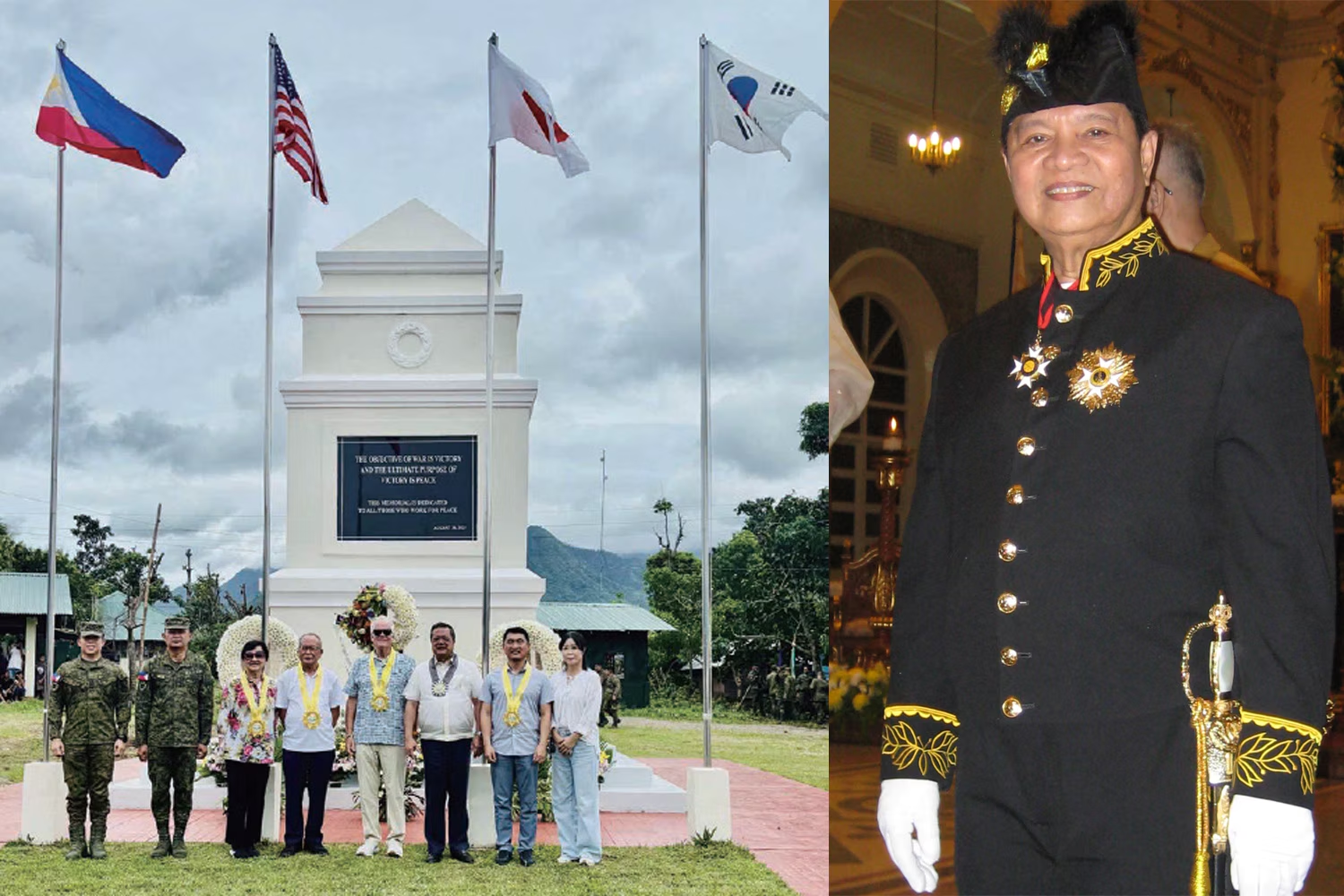
In August, a peace memorial and cenotaph displaying the flags of the Philippines, the United States, Japan, and South Korea, was founded in Murcia, Negros Occidental. This was brought by the strong dedication of a Filipino historian who longed for peace and friendship between the Philippines and Japan. We spoke with 86-year-old historian Modesto Sa-onoy, a native of the province, about his story behind this memorial and his research on the history of Japanese occupation.
"I wanted to build this memorial because I also had good memories with the Japanese,"
he began, as rain fell outside and he sipped coffee sweetened with Negros' renowned muscovado sugar, recalling his childhood memories.
Childhood Memories with a Japanese Soldier
Sir Sa-onoy was born in 1938 into a family that ran a rice mill in the province. In 1942, when the Japanese Imperial Army landed on Negros, as a young boy he remembers being carried on the shoulders of a tall Japanese soldier.
"Japanese soldiers often came to use our rice mill, and one tall soldier would frequently give me shoulder rides and take me along to stroll through the market. He was so tall that I called him 'Big Boy.'"
As he recounted this, his face lit up with a nostalgic smile.
His interaction with the Japanese actually began even before the war. "There was a neighborhood playmate named Ray Haba, whose father was Japanese and mother was a local schoolteacher. When the war broke out, his father changed into military uniform, and the family relocated." Not only the Haba family, but many Japanese had already lived in Negros before the war, working as gardeners, cooks, or agricultural instructors.
In elementary school, Sa-Onoy learned Japanese and memorized popular songs of the time. He was able to sing with nostalgia "Akatuki ni inoru" (Prayer in Morning) and "Aikoku Koshinkyoku" (Patriotic March), popular Japanese songs at that time. "I didn't understand the meaning, but I liked the music. I also learned dances with the songs," he said, rising from his seat to demonstrate the dance he had been taught. Every Sunday, festivals were held at the garrison, where he saw films showing Mt. Fuji and ate mochi rice cakes.
Witnessing the Horrors of War During Evacuation
In 1944, as U.S. forces landed on Leyte, many Japanese units from Negros were sent as reinforcements. Departing Japanese soldiers handed out pencils, papers and sportswear, and Sa-onoy himself received a baseball thrown by one of them.
His family evacuated to the mountains in anticipation of bombings and urban warfare, and there he first saw the hunger and poverty suffered by rural communities.
"Our family was fortunate to not suffer from hunger, but that was only because of our circumstance. There is no war without suffering. There is no war without civilian victims,"
he reflected.
The soldier he had affectionately called "Big Boy" died when the transport ship he was on was sunk. "I was very sad when I learned that. He was such a good man," he lamented.
"My wish to build this memorial also came from those good memories with the Japanese. Of course, the larger reality was different, people suffered from hunger and poverty,"
he said, sharing his complex feelings about that time.
Remembering Koreans and Others from the Peninsula
The presence of Korean visitors was also significant in the establishment of the memorial. While considering the location for the site, Sa-onoy heard that Korean visitors often laid flowers at a certain place in Murcia. Korean priests also visited, though at that time it was a simple site with only a few flowers. After telling the local mayor that this was where the Japanese Imperial Army had surrendered, the decision was made to erect the memorial there. Construction was funded by the Philippine government.
"Most of those who worked at the airfield were from the Korean peninsula or China. Among the surrendering soldiers, there were even cases where they cried out, 'We are Chinese!' as they surrendered," Sa-onoy explained, recalling the laborers and soldiers.
Writing Against the Rising Sun - For an Impartial Historical Study
One of Sa-onoy's major works as a historian is Against the Rising Sun (2011), a study of the Japanese occupation of Negros. Using new materials, it details not only atrocities by Japanese forces but also damage caused by Filipino guerrillas, including civilian cases.
On the destruction of houses, he had long been taught that it was the work of the Japanese, but in his book, he also makes reference to the "scorched earth" tactics implemented by the guerrillas.
"I don't deny the cruelty of the atrocities committed by the Japanese army. And as a Filipino, part of me wants to defend the guerrillas. But historical research must be fair."
he explained.
A Wish for Peace
"My own cousin was killed by Japanese soldiers. I don't even know where he is buried. With this cenotaph, I can at least offer prayers for his soul. This site is also where four nations gathered for peace. I hope more people realize of the uselessness of war,"
Among his other works are History of Negros Occidental and History of Bacolod. And he continues his historical research. His son Aufred, runs Mansion de Bacolod, a restaurant in a restored ancestral home in Bacolod City, carrying forward his father's devotion to history. The cenotaph and memorial stands as a symbol of commitment and advocacy of a Filipino historian, wishing for peace and friendship between the Philippines and Japan.