Silay’s Heritage District Aims for UNESCO World Heritage. A Future for Cultural Heritage and Tourism Policies
 |英字
|英字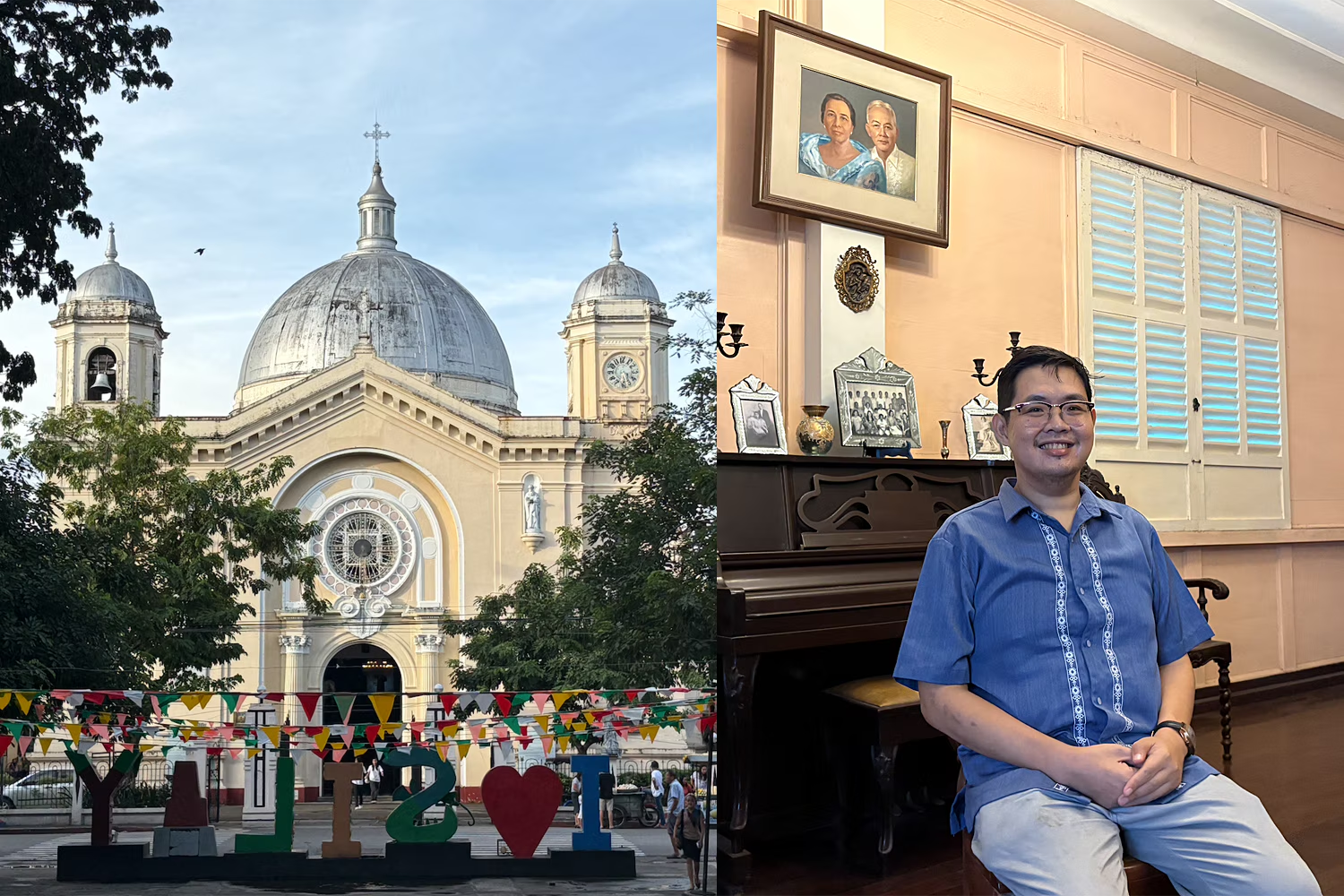
Silay in Negros Occidental, is perhaps for Japanese readers known for the mountains of Patag where the Japanese troops made their last stand. It also witnessed its cathedral narrowly escaping destruction during the Japanese retreat. Local stories recall how a young lieutenant defied orders to destroy the cathedral—perhaps moved by its beauty or the plight of the refugees sheltering inside. Today, this city that once thrived in the golden age of the Philippine sugar industry has become a candidate for UNESCO World Heritage registration. We spoke with Solomon Locsin, Chairperson of the Negros Occidental Historical Council, who is spearheading efforts toward heritage recognition and tourism policy in Silay.
From Tourism Officer to Training in Japan
“China has the Great Wall, India has the Taj Mahal, and Japan has its ancient temples. But the Philippines lacks a heritage site that represents our nation,” Locsin reflected on the state of his country’s cultural heritage. At the turn of the 20th century, Silay flourished through sugar exports, leaving behind a mix of colonial, Art Deco, and Filipino-Spanish architectural styles. Japanese gardeners were employed in the city. Though many buildings survived the war, economic decline later placed them under threat of demolition. When Locsin began working at Silay’s tourism office, he saw many of these structures deteriorating amid a city with few tourist attractions.
A turning point came when he joined a JICA training program in Akita Prefecture, Japan. There he saw well-preserved farmhouses and participated in the local Namahage folk tradition, which gave him the idea of revitalizing Silay’s tourism through cultural preservation. “Seeing how old houses in Akita were restored and repurposed for community events, I realized Silay could pursue a similar path,” he recalled.
Pushing Heritage Protection Amid Development Pressures
After earning a master’s degree in public policy in Manila, Locsin was elected as a city councillor in Silay and began drafting heritage protection policies. “I worried whether heritage conservation would gain support at a time when development and economic growth were the priorities,” he spoke. Contrary to his fears, Silay residents welcomed his proposals. Between 2014 and 2015, the city established a designated “heritage district” and enacted measures such as exempting heritage structures from property tax. Even fast-food giant Jollibee opened a neo-colonial style design branch that was dubbed “the most beautiful Jollibee in the Philippines.” Ancestral houses were converted into hotels and restaurants, and inquiries from investors eager to acquire old mansions became frequent. Young visitors, drawn by “Instagrammable” backdrops, have also been on the rise.
Influenced by Japan’s Conservation Philosophy
As one of his guiding principles for his work, Locsin cites the “Nara Charter on Authenticity” (1994), an international charter inspired by Japanese traditional architecture. Instead of perpetually preserving the totality of the structures, the Charter gave equal value and recognition to restoration practices using the same materials and techniques. He illustrated this with an example of a restored mansion floor where newly crafted tiles, made with traditional methods, coexist seamlessly with the old.
The Road Toward UNESCO Recognition
With tourism initiatives and legal frameworks in place, a new opportunity emerged when the Department of Tourism proposed a sugar heritage tour for the Western Visayas. Highlighting the history and legacy of the sugar industry, the concept caught the attention of UNESCO Philippines. UNESCO welcomed the plan’s comprehensive approach, which included not only the achievements but also the darker aspects of sugar history.
“We want to acknowledge the history of the labourers of the past, but also the philanthropic contributions of sugar families who built hospitals and schools,” Locsin explained. “With the history of both light and darkness in mind, it is also a process of healing.” Local sugar companies, too, have expressed support for the bid.
The proposed heritage site is titled the “Sugar Cultural Landscape of Negros and Panay Islands,” encompassing sugar mills, heritage houses, and heritage districts in Iloilo and Silay. It was officially added to UNESCO’s tentative list last year, with hopes of full registration by 2027.
A Vision for Philippine Cultural Heritage
“In a country as diverse as the Philippines, unity through culture is vital. Silay represents what Filipinos achieved during the colonial era and stands as a testament to their craftsmanship. It is part of our history and national identity,” Locsin emphasized. Speaking on the future of heritage preservation, he concluded: “For many old mansions we have lost traces of the original owners. But if new owners continue the preservation, new stories will be written into these houses. That, in itself, carries meaning.”
By Yoshikaze Kawakami