Edcom 2: Improvements seen, but half of learners still below grade level in literacy
 |英字
|英字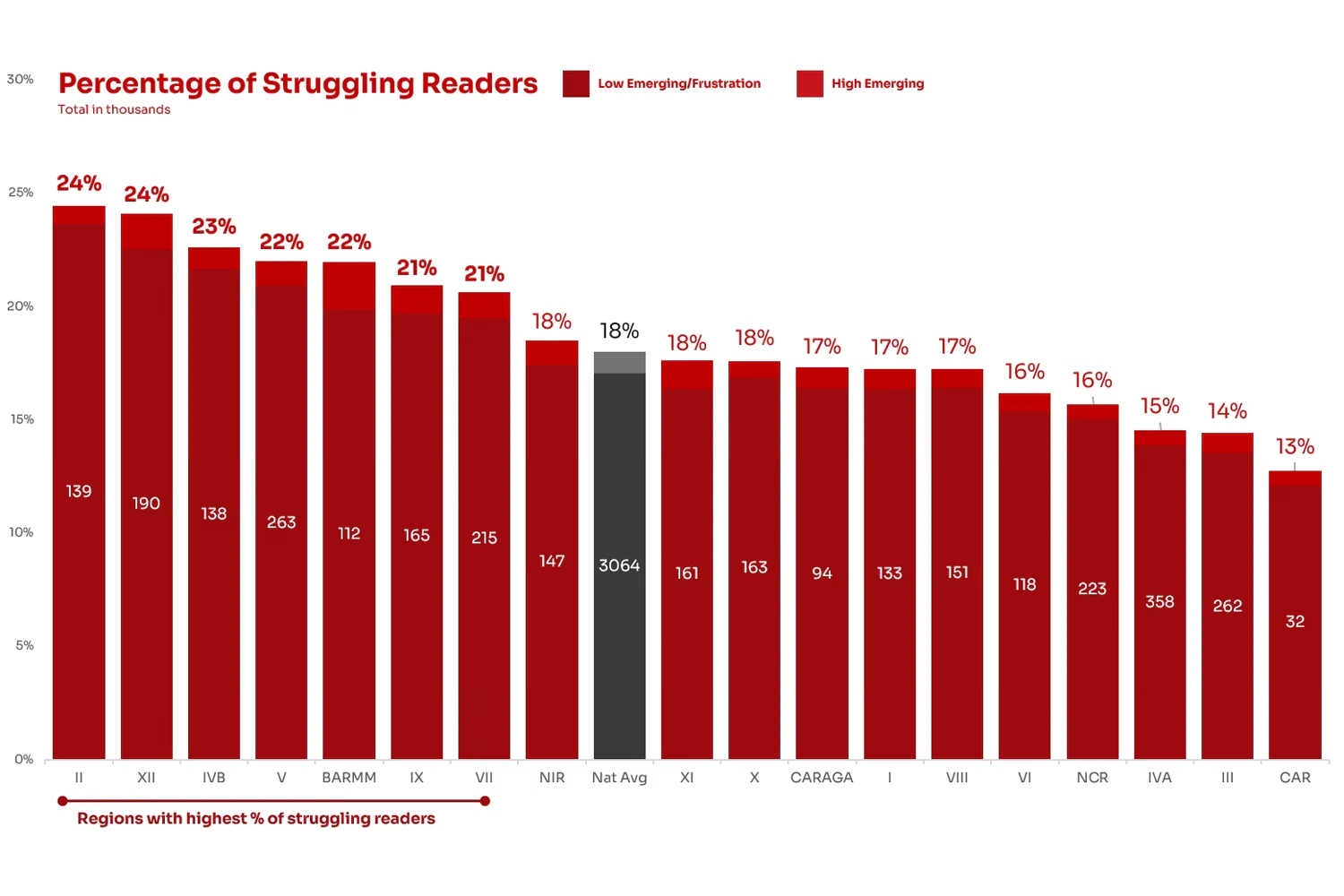
Filipino learners made measurable gains in reading proficiency in school year 2025–2026, but nearly half still failed to meet grade level expectations by the end of the school year in March, according to analysis by the Second Congressional Commission on Education (Edcom 2).
The results are based on three major literacy assessments implemented by the Department of Education (DepEd). For early grades (Grades 1 to 3), DepEd used the Comprehensive Rapid Literacy Assessment (CRLA), where learners are categorized from Low Emerging to Grade Level Ready.
For Grades 4 to 10, the Philippine Informal Reading Inventory (Phil-Iri) is used, where at the beginning of the school year (BOSY) learners are classified by how many grade levels they are behind.
By the end of school year (EOSY) they are categorized as Frustration, Instructional, or Independent readers, reflecting their ability to read with or without support.
For Grade 11, DepEd piloted for the first time the Senior High School Literacy and Numeracy Assessment (SHS-LNA) in March 2026, covering around 1.4 of 1.9 million learners across both public and private senior high schools nationwide.
Across these assessments, results show consistent improvement within the school year, while also revealing that a large share of learners (18 percent or 3 million out of 16.5 million learners) remain in non-proficient reading levels following the first full year of implementation of the ARAL Program.
Using DepEd data on the nationwide literacy assessments, Edcom II finds that an average of 40 percent of learners from Grades 1 to 10 were classified as Struggling Readers at the beginning of the school year.
Meanwhile, by the end of the school year (EOSY), the proportion of learners considered Grade Level Ready or Independent readers rose from 19 percent in June 2025 to 48 percent in March 2026, reflecting
a 29 percent point improvement. However, despite this progress, 1 in 2 learners remained below grade-level reading proficiency by the end of the school year.
The Commission flagged significant disparities in reading outcomes across regions, with learners in Region II, Region VII, and Region IV-B, posting nearlt double the share of struggling readers compared to higher- performing regions such as CAR, Region III, and NCR.
Literacy gaps remained especially pronounced in high school. While improvements were observed in earlier grades in elementary, these appear to taper off in later grades, and especially in Grades 7 to 10, with many learners unable to become independent readers as academic demands become more advanced.
The situation is most stark in Senior High School. In DepEd’s pilot Senior High School Literacy and Numeracy Assessment (SHS-LNA), 87 percent of Grade 11 students are not Independent readers, with only, 12.58% demonstrating the ability to read and understand texts without assistance — from identifying explicit details, making inferences, and drawing conclusions, to explaining main ideas, summarizing information, and engaging with academic texts expected at the Senior High School level.
The majority of learners were classified under the Frustration level (58.9%), meaning they are unable to read grade-level material independently, while 28.5 percent at the Instructional level, requiring teacher support to understand texts.
“We commend DepEd for undertaking a comprehensive literacy assessment, even going the extra mile to examine how our students are doing in Senior High School,” said Edcom 2 Executive Director Karol Mark Yee.
“This baseline data provides a clear starting point on the refinement of interventions as DepEd conducts the ARAL Summer Program, and prepares for the second year of the full rollout of ARAL interventions.”
“We see that in the first full year of ARAL alone, significant progress has been made already in supporting our students, following the hard work of the agency and our teachers,” continued Yee. “Moving forward, our task now is to design specialized supports to our students in high school, and to better differentiate interventions to help our students actually reach “grade level readiness”, Senate of the Philippines