US sent aircraft carrier strike group join drill with Japan, Philippines
 |英字
|英字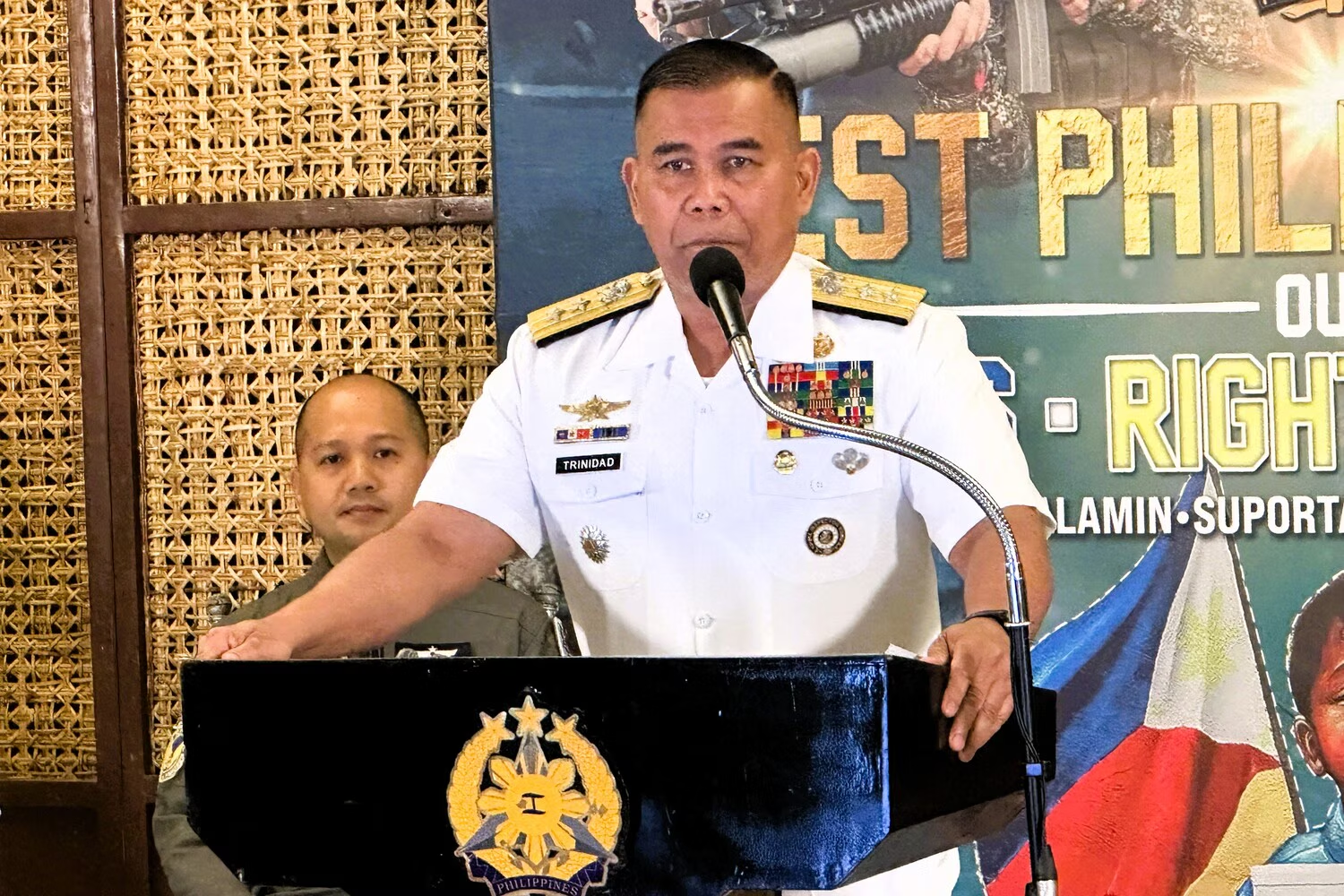
The United States deployed an aircraft carrier strike group, one of its "most potent combination of naval assets" during the recent Multilateral Maritime Cooperative Activity (MMCA) with Japan and the Philippine forces in the West Philippine Sea, a military spokesman revealed on Tuesday.
In a press briefing, retired RADM Roy Vincent Trinidad, Armed Forces of the Philippines (AFP) spokesperson for West Philippine Sea said the 17th MMCA conducted from July 21 to 25 was participated the USS George Washington Carrier Strike Group together with JS Yuudachi from Japan, and Philippine Navy's BRP Antonio Luna, AW109 helicopter, Philippine Air Force FA-50 fighter aircraft, TC90, an A-29B Super Tucano, a C-208B aircraft, and a Sokol Search and Rescue (SAR) helicopter.
The Philippine Coast Guard also sent BRP Melchora Aquino and BRP Malabrigo in support of the activity.
"These were conducted in the waters west of Zambales and east of Bajo de Masinloc (or Scarborough Shoal)," he said.
Trinidad did not give details of the assets that are part of the US carrier strike group but he noted that "in general it would consist of an aircraft carrier, a cruiser, three or four destroyers with accompanying aircraft and submarine support."
"A carrier strike group is centered on aircraft carriers. It has an accompanying cruiser for air defense and destroyers for surface action. It is always accompanied by the appropriate air cover and submarine support. It is the most potent combination of naval assets around the world," he said.
"This will include different activities wherein the carrier strike group would operate and interact with our own ships and that of the Japanese Maritime Self-Defense Force. It will be safe to assume this will include cross-deck landings, replenishments at sea, communication exercise, anti-submarine warfare, and a host of other activities that our Navy and our Air Force are now capable of doing," he added referring to the exercises participated by the carrier strike group of the United States.
Days after the MMCA, Trinidad said the People's Liberation Army Navy (PLAN) conducted military drills for the first time over the area of Bajo de Masinloc.
"After numerous false narratives by the Chinese Communist Party of conducting drills in Bajo de masinloc the AFP was able to monitor last 31 July and 01 August the conduct of drills by the PLA Navy consisting of five warships, one replenishment ship, two hovercrafts, two helicopters and unidentified number of fighter aircraft," he said.
However, unlike the MMCA that is regularly being done by the AFP and its allied forces, Trinidad said it is still a "big question" if China can sustain their military drill in the area.
"It also coincided with the celebration of the 99th anniversary of the PLA, last 01 August. As to whether this is a sustainable activity, it's questionable," he said.
"This is the first time that we have observed and monitored, then conducted it. Whether this could be sustained or not is still the big question," he added.
Based on the monitoring of the AFP, Trinidad said a total of 48 Chinese vessels were monitored in the West Philippine Sea in the entire month of July.
These include the China Coast Guard vessels and PLAN ships in Ayungin Shoal (14 vessels), Bajo de Masinloc (22 vessels), Escoda Shoal (four vessels), and Pagasa Island (8 vessels). Robina Asido/PHS